


Adaptation Options Database for Caribbean part of the Dutch Kingdom
We worked together to develop a database that strengthes national adapation strategies
Customer
Location
Duration
Read more
International Panel on Deltas and Coastal Areas
Caribbean part of the Dutch Kingdom
2025-2026
Adaptation Options Database for Caribbean part of the Dutch Kingdom
We worked together to develop a database that strengthes national adapation strategies
Customer
Location
Duration
Read more
International Panel on Deltas and Coastal Areas
Caribbean part of the Dutch Kingdom
2025-2026

Since 2024, we have been involved in a wide range of adaptation projects in the Caribbean part of the Kingdom. One of these projects is the development of an Adaptation Options Database: a broad, English-language database with measures and other actions that help local stakeholders protect their island against weather extremes.

Why this database?
With the Adaptation Options Database, we build on the climate impact atlases developed for Aruba, Curaçao, and St. Martin. Governments, professionals, and students can use the database to identify actions that better protect their island. It offers inspiration, practical examples, and clear guidance, developed together with local partners and knowledge institutions in the Caribbean.
What does the database contain?
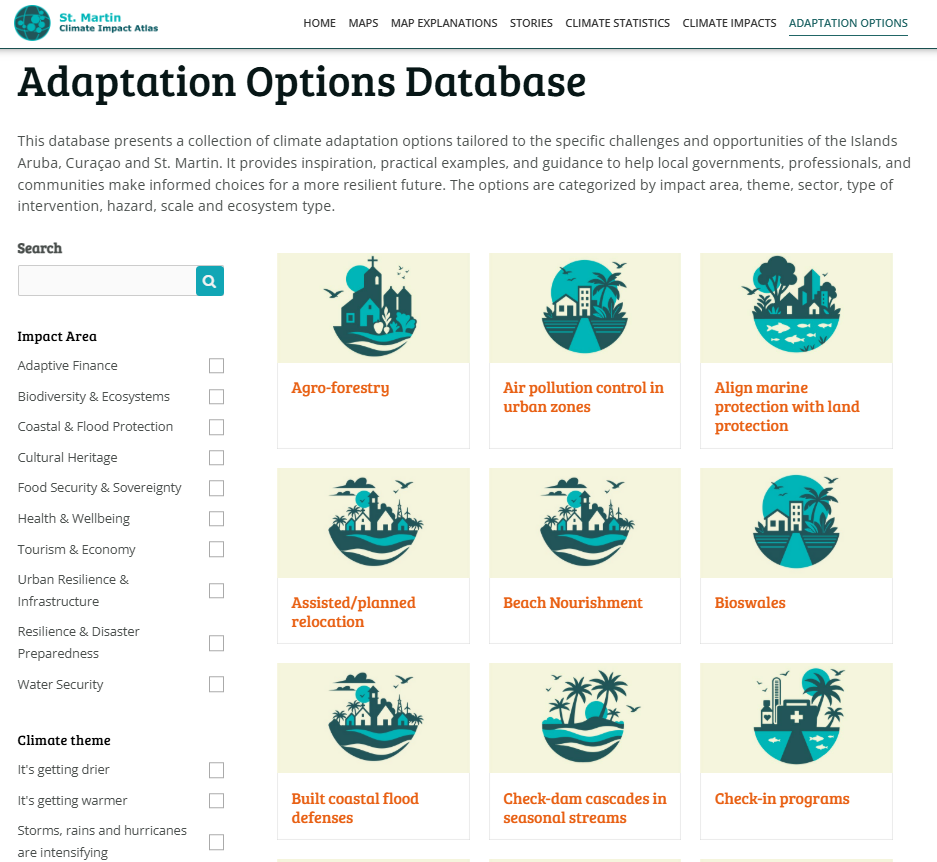
The database presents more than one hundred actions suitable for islands. Users can filter actions by impact area, climate theme, climate risk, sector, scale, and ecosystem type. For each type of action, the database provides information on what is needed to implement it, possible co-benefits, considerations related to equity and vulnerability, and indicative costs.
What is the purpose of the database?
One of the main goals of the database is to strengthen the national adaptation strategies of the islands. It supports governments and professionals in making well-informed and transparent choices to increase resilience to climate extremes.
Which partners were involved?
The database was developed within the programme of the International Panel on Deltas and Coastal Areas (IPDC). The project was led by Vrije Universiteit Amsterdam, in collaboration with the University of Curaçao, the University of Aruba, and the University of St. Martin. A network of regional and international knowledge partners also contributed, including Wageningen University & Research, Deltares, RE-Quest, and Impact Blue.
What is CAS’s role?
CAS was responsible for the technical development of the database and for integrating it into the existing climate impact atlases. We also remain available in the background to support questions related to the technical management of the database.
What’s next in the project?
The database has been integrated into the climate atlases developed in recent years for Aruba, Curaçao, and St. Martin, bringing all relevant climate information together in one place. The aim is for an editorial team linked to the island universities to manage and further develop the database in the future.
Why this database?
With the Adaptation Options Database, we build on the climate impact atlases developed for Aruba, Curaçao, and St. Martin. Governments, professionals, and students can use the database to identify actions that better protect their island. It offers inspiration, practical examples, and clear guidance, developed together with local partners and knowledge institutions in the Caribbean.
What does the database contain?
The database presents more than one hundred actions suitable for islands. Users can filter actions by impact area, climate theme, climate risk, sector, scale, and ecosystem type. For each type of action, the database provides information on what is needed to implement it, possible co-benefits, considerations related to equity and vulnerability, and indicative costs.
What is the purpose of the database?
One of the main goals of the database is to strengthen the national adaptation strategies of the islands. It supports governments and professionals in making well-informed and transparent choices to increase resilience to climate extremes.
Which partners were involved?
The database was developed within the programme of the International Panel on Deltas and Coastal Areas (IPDC). The project was led by Vrije Universiteit Amsterdam, in collaboration with the University of Curaçao, the University of Aruba, and the University of St. Martin. A network of regional and international knowledge partners also contributed, including Wageningen University & Research, Deltares, RE-Quest, and Impact Blue.
What is CAS’s role?
CAS was responsible for the technical development of the database and for integrating it into the existing climate impact atlases. We also remain available in the background to support questions related to the technical management of the database.
What’s next in the project?
The database has been integrated into the climate atlases developed in recent years for Aruba, Curaçao, and St. Martin, bringing all relevant climate information together in one place. The aim is for an editorial team linked to the island universities to manage and further develop the database in the future.